
Hair and Makeup Trial: How to Run One Before a Shoot

A hair and makeup trial is a rehearsal for the look. The artist builds it, the talent wears it, and the person paying for it sees it under real conditions before the clock and the budget are running. The practice comes from weddings, where it is standard. It transfers to campaigns, lookbooks, runway shows and brand events, because the problem is the same: a look that exists only as a mood board is a risk until it sits on a face. Book the trial one to three months ahead for a wedding. For a commercial job, book it as soon as the talent is confirmed and early enough to change course. This guide covers timing, duration, cost benchmarks, preparation, assessment and the questions to settle in writing.
TL;DR
- A trial tests the look on the actual person, in the actual light, before the shoot or event day. It is a rehearsal, not an exam.
- Plan roughly 1.5 to 3 hours for a combined hair and makeup test. Multiple looks and adjustments extend it.
- US wedding benchmarks run from about $75 to $200 for a single-service trial and from $150 to more than $400 combined. Treat these as a budgeting reference, not a quote.
- Judge the result across the day and under several light sources, then give feedback in specifics, not adjectives.
- Confirm in writing who works on the day, call times, touch-ups, overtime and cancellation terms.
Table of Contents
- What a trial is, and what it settles
- When a trial earns its place on a production
- When to book it
- Same day or separate appointments
- How long a trial takes
- What a trial costs
- Preparing the talent and the brief
- Judging the result
- What to confirm in writing
- Booking the talent and the team through one agency
- Perspective: the trial as part of casting
- FAQ
- Sources
What a trial is, and what it settles
In its wedding form, a trial is a dedicated appointment of roughly 1.5 to 3 hours in which the look is tested and refined. It tends to open with a consultation on inspiration, the outfit, the venue and any hair or skin concerns. Application and styling follow, then adjustments. The order shifts from team to team, but the arc stays the same: talk, build, assess, revise.
For someone commissioning talent, the trial settles four things that a portfolio and a mood board cannot.
- Translation. A reference image shows a finished result on a different face, under different light. A trial shows how that direction behaves on this person’s skin tone, hair texture and bone structure.
- Compatibility. The artist and the talent meet before the pressure of a call time. If the pairing does not work, it is discovered while there is still room to change it.
- Durability. A look that is flawless at 8 a.m. may crease, fade or collapse by 2 p.m. under studio lamps or Gulf heat. Better to learn it now.
- Time. The trial gives a real measurement of how long the look takes, which feeds directly into the call sheet.
The Knot, in its guide, notes that trials are not required but highly recommended, since they prevent surprises and build confidence. They are most useful when trying new products or techniques, working with a new artist or pursuing a highly specific look.
When a trial earns its place on a production
Not every job needs one. The same guidance notes that skipping can be reasonable when you know and trust the artist’s aesthetic, and a trial may be unnecessary when a regular artist repeats a look already worn successfully. A simple product shot with a familiar team is an example.
Book one when any of the following applies:
- A new artist and a new face. Neither has worked together, and the talent was chosen from a shortlist.
- A specific, stylized direction. Editorial looks, period references, bold color, sculpted hair or prosthetic-adjacent work. The more specific the idea, the more a test pays back.
- A hero asset. A campaign face, a billboard, a launch film. Mistakes here are the costliest to reshoot.
- Multiple talent who must read as one world. A cast of models, a brand ambassador group, or a group of hostesses presented as a unified look.
- Skin or hair constraints. Allergies, sensitive skin, extensions, wigs, or hair that has been recently colored or cut.
- A hard schedule. Events with a fixed doors-open time cannot absorb a look that takes an hour longer than planned.
For kids, teens and anyone with sensitive skin, the trial is also where product choices are checked before the day, with the parent or guardian informed of what will be used.
When to book it
The wedding rule of thumb is to schedule the trial one to three months before the event. Commercial calendars move faster, so translate the principle rather than the number: hold the trial late enough that the concept is locked and the talent is confirmed, and early enough that a second round is still possible.
A workable production sequence:
- Lock the creative direction and the talent.
- Share references and the wardrobe with the artist.
- Hold the trial, ideally in the same type of light as the shoot.
- Allow a window for revisions and, if needed, a short second test.
- Freeze the look in photographs and written notes, then circulate them to everyone who will work on the day.
Demand matters as well. When artists or dates are in high demand, the trial itself may need to be booked six to twelve months ahead, which is a wedding-season figure but a fair warning for fashion weeks, Ramadan campaign season, and the busy shoot months in the Gulf.
Be mindful of what a late change costs once talent is booked. ANT Management’s booking terms state a 50% charge for cancellation within 48 hours, 100% within 24 hours, and 100% for confirmed trips. A trial held in good time keeps you away from last-minute changes that put those terms into play.
Same day or separate appointments
Testing hair and makeup together gives the fullest picture, because the two have to work as one composition: a sleek low bun changes how a bold lip reads, and a heavy eye changes how much hair volume feels balanced. Experts quoted by The Knot point to a combined session as the fullest test, while noting that separate appointments are workable when artists or schedules differ.
A practical way to decide:
| Situation | Better approach |
|---|---|
| One artist covers both disciplines | Single combined session |
| Hair and makeup artists are different people | Combined if schedules allow, so they see each other’s work |
| Hair requires a long build, such as extensions or sculpted styles | Separate hair session, then a short combined check |
| Talent is traveling in from another city | Combined, with a buffer for revisions |
| Several talent need the same look | One lead test, then a shorter check for each additional person |
The same logic holds for events that run on a long, layered schedule, such as a wedding with entertainment, lighting design and photography. A planner coordinating wedding event design and entertainment alongside beauty will want the trial timed so the final look is photographed and approved before the other moving parts lock.
How long a trial takes
Plan on the generous side. Reported figures vary by market: one Australian industry source cites 1.5 to 3 hours for hair and 1.5 to 2 hours for makeup, noting that multiple looks and adjustments extend the appointment. For a combined test, the figure commonly given is 1.5 to 3 hours.

For a production, add time for what a wedding does not require: a wardrobe check against the look, test photographs under shoot lighting, and a short review conversation with whoever owns the creative direction. A half-day block is a sensible default when the look is complex, and a shorter one suits a simple, repeat look.
The measured time is the most useful output of the whole exercise. If the test look takes 90 minutes with one artist, the call sheet for eight talent cannot assume one artist and a 9 a.m. start. Use the figure to decide how many artists and assistants the day needs. Overtime is also a cost line worth knowing: ANT’s booking terms list overtime at 15% per hour, so a look that runs long on set has a direct price.
What a trial costs
There is no universal rate card, and commercial beauty work is priced by the job, the usage and the artist. For orientation, the clearest published benchmarks are US wedding prices. The Knot reports individual trials at $75 to $200 each and combined trials from $150 to more than $400, with location, artist expertise and inclusions all moving the number. Another US guide gives combined trials at $200 to $550, with hair-only at $100 to $250 and makeup-only at $100 to $300.
Two cautions for budgeting. First, these ranges describe individual wedding clients, not a brand booking an artist for a campaign, so use them as a floor for thinking, not a quote. Second, ask whether the trial fee is credited against the day rate, whether travel is charged, and whether a second test costs extra. Those answers change the real total more than the headline number.
Preparing the talent and the brief
A trial is only as good as its inputs. The preparation advice below comes from wedding practice and holds for any client who has to look their best at a specific time.
For the talent
- Follow the artist’s own preparation instructions first.
- Arrive with clean, dry hair free of oils, heat styling and products, and clean, well-moisturized skin.
- Bring any extensions, accessories, preferred lashes or products that will be worn on the day.
- Share allergy information in advance, so products can be chosen safely.
For the person commissioning
- Curate the references. A short, edited set beats a folder of fifty images. Pin down what you like in each: the lip, the parting, the finish of the skin.
- Send photos of the wardrobe, headpieces and jewelry. Neckline and fabric color change what works.
- Describe the context: indoor or outdoor, flash or continuous light, still or motion, how long the talent will be on set.
- Keep the room small. One trusted decision-maker is more useful than a crowd, and a single point of feedback avoids contradictory notes.
Precision in the brief pays off. Guidance on trial checklists stresses precise visual references over vague labels such as “natural,” “boho” or “vintage,” which mean different things to different people. A direction like “skin that reads as satin, not matte; brows brushed up and left soft” travels intact from your head to the artist’s hands.
Judging the result
The first look in the mirror is the least reliable one. The Paperlust guide recommends wearing the finished look for the rest of the day, walking around, eating and going outdoors, then noting what happened: lipstick that faded, eye makeup that creased, hair that dropped.
A useful assessment routine for a production:
- Photograph in four conditions: window light, outdoors, indoor artificial light, and phone flash. Flash is the harshest and reveals what a press photographer will see at an event.
- Move. Have the talent turn, walk, sit and gesture in the styling. A look built for a still frame must also survive motion if the job includes video or a runway.
- Test it against the wardrobe. Hair and makeup that look right alone can fight a neckline or a color.
- Wait. Check again two and four hours later. Longevity is the point of a trial.
- Record. Save the photographs and write down the products, tools and sequence while they are fresh.
Giving feedback the artist can use
The artist works from specifics. “Soften the eyeliner at the outer corner” or “reduce the brow definition by half” can be acted on at once. “Make it more elegant” cannot. Good artists treat the session as a collaboration. Vogue India’s advice on booking a makeup artist says the client should feel heard and informed throughout, which is as true for a brand representative as for a bride.
What to confirm in writing
A successful trial can still be followed by a troubled shoot day if the logistics were left to goodwill. Settle these points in writing before the day. They draw on wedding checklists but apply directly to commissioned work:
- Who will perform the day-of service, and whether a backup exists if they are unavailable.
- Call times and duration for each person, including the order in which talent are done.
- What the package includes: assistants, touch-ups, product list, number of looks.
- Equipment and space: a chair, a mirror, power, natural light, a clean surface.
- Travel charges and location costs.
- Changes, overtime and cancellation terms.
One Fab Day lists who performs the service, backups, timing, space, travel, products, payment and touch-up instructions among the questions to ask. Vogue India likewise suggests confirming the team, call times, inclusions, touch-ups, travel, changes, overtime and cancellation terms in writing. A short confirmation email, signed off by both sides, is enough.
Booking the talent and the team through one agency

A trial involves at least three people: the talent, the hair and makeup artists, and the person who will style the look. Coordinating them across separate suppliers means three calendars, three sets of terms and three points of failure. ANT Management books models, kids and teens, actors, influencers, athletes, stunt performers, hostesses, promoters and creative crew through one agency, so the people in front of and behind the camera can be arranged in one brief. Exclusive stylists and full production crew are among the creatives available, and ANT books talent for shoots, events and shows anywhere in the world.
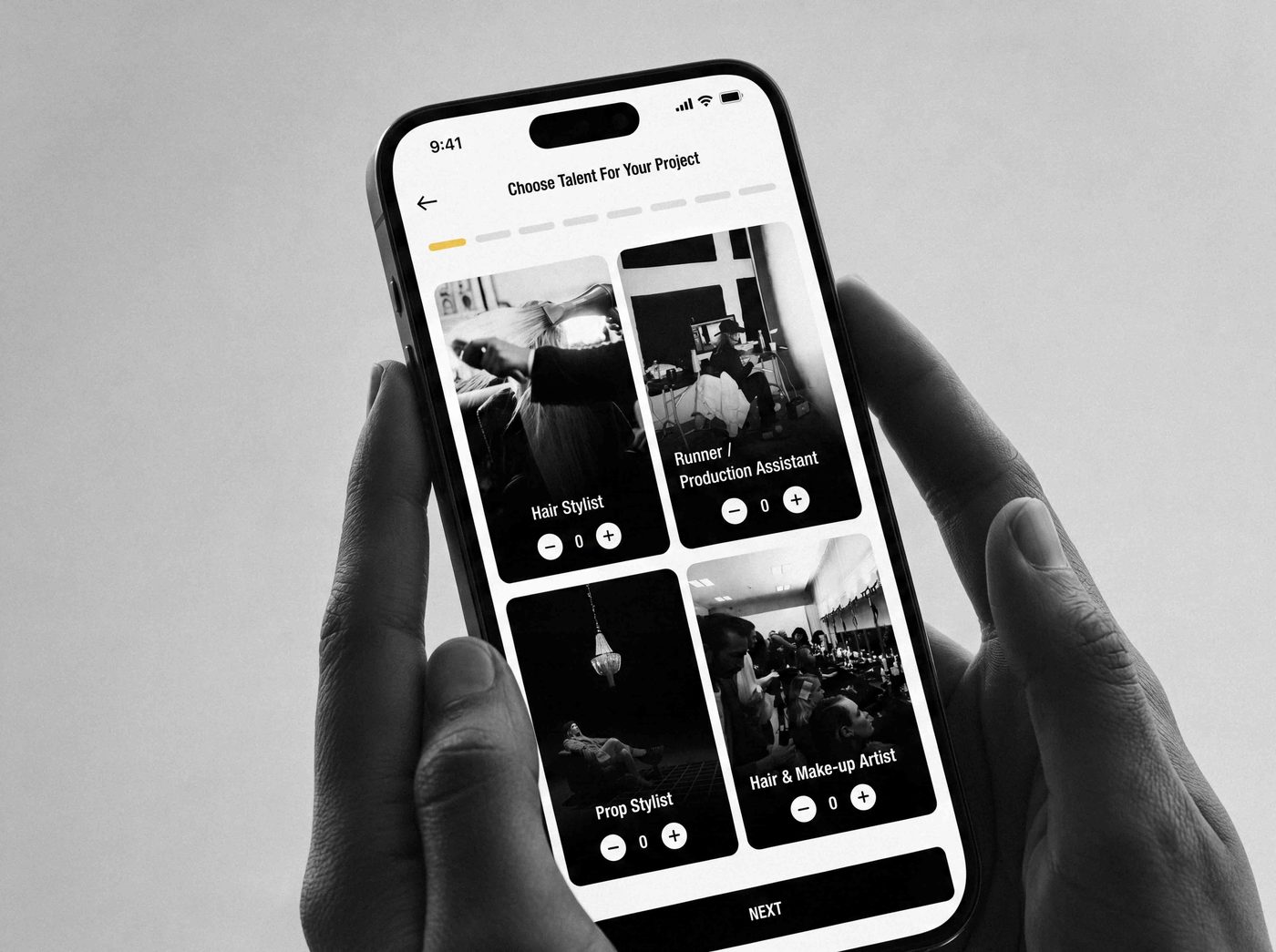
Send a brief and receive a shortlist of available talent within an hour in working hours. Or post a job in the ANT Talent App, where vetted talent can be booked directly with payment held until the job is done. For the model and talent side of a shoot, the talent booking page shows the range available.
The ANT Talent App lets you post a job and book vetted models, actors, influencers and creatives in Dubai in minutes, with escrow-protected payment processed by Stripe. Profiles are verified, and coverage extends across the UAE, Kuwait, Qatar and Saudi Arabia. Current prices are shown in the app. Clients who prefer a managed service can book through ANT Management directly at info@antmgmt.com. The full range of services is on the ANT Management home page.
Perspective: the trial as part of casting
We treat the look as part of the casting decision, not an afterthought to it. A face chosen from a portfolio is a promise; the trial is where the promise meets the brief.
Our clients book models, actors, influencers, kids and creative crew for shoots and events, and the same pattern appears whenever a concept is specific: the best results come when talent, stylist and artists meet before the day, with one clear reference set and one person who decides. Because we book both the people in front of the camera and the creatives behind it, a trial can be arranged as one coordinated step instead of a chain of separate calls.
Our approach is to keep the brief tight, the shortlist fast and the payment protected, so the creative energy goes into the look itself. Whether the job is a campaign in Dubai or a show abroad, the principle holds: rehearse the image, then book the day.
ANT
FAQ
How long does a hair and makeup trial take?
A combined trial commonly runs 1.5 to 3 hours. Testing more than one look, or making adjustments, extends it. For a production, add time for wardrobe checks and test photographs.
How much does a hair and makeup trial cost?
In the US, wedding trials are reported at $75 to $200 individually and $150 to more than $400 combined. Commercial rates depend on the artist, the job and the usage, so ask for a quote and confirm whether the trial fee is credited against the booking.
Is a trial worth it if I already know the artist?
Often not, when the artist is trusted and the look is one they have already done well. A trial earns its cost when the direction is new, specific or high-stakes, or when the artist and talent have not worked together.
Should hair and makeup be tested on the same day?
Yes where possible. Together they show how the two elements balance, and the artists can see each other’s work. Separate sessions are workable when artists or schedules differ, followed by a short combined check.
What should talent bring to a trial?
Clean, dry hair and a clean, moisturized face, plus accessories, headpieces, extensions, preferred lashes or products, and any allergy information. The commissioning side should bring a short, edited set of references and photos of the wardrobe.
Sources
- Wedding Hair and Makeup Trial 101: Cost, Tipping, Booking, and More, The Knot
- The Essential Wedding Hair and Makeup Trial Checklist, One Fab Day
- What to Expect at a Bridal Hair and Makeup Trial, Paperlust
- How Much Does Wedding Hair and Makeup Cost? (2026 Guide), Paperlust
- Do you pay for a wedding hair and make up trial?, Easy Weddings
- Everything you need to know before booking a bridal makeup artist, Vogue India
- Weddings, LJDJs Event Design & Entertainment
Ready to book? Send a booking request to ANT Management at antmgmt.com/dubai/contact, or post a job on the ANT Talent App.
Recommended
Planning a shoot in Qatar?
Prefer to book on your phone?
Post a job on the ANT Talent App and let approved talent come to you.
- Every profile approved by ANT
- Chat with talent in the app
- Payment held until the job is done

Free on iPhone
- 5.0on Google, 200+ reviews
- Since 2022modelling and talent agency
- Worldwideshoots, events and shows anywhere
- Licensed in Dubai. See our licence and booking terms